


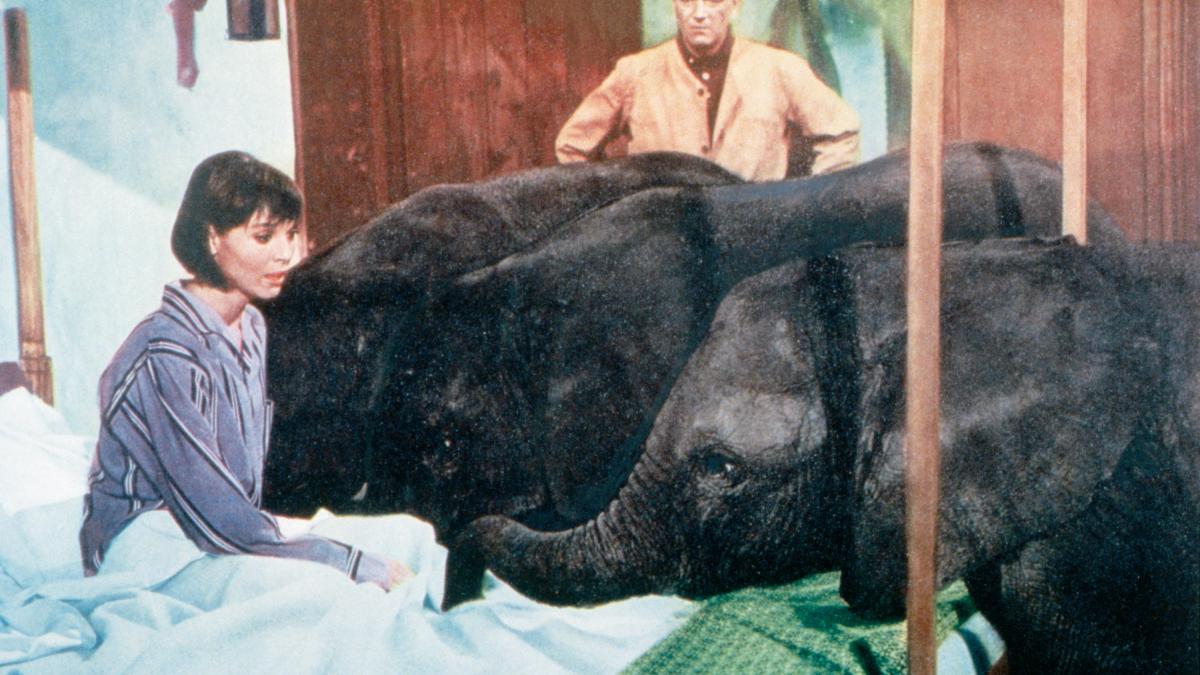
"Howard Hawks and an obviously expert troupe of hunters and photographers gorgeously illustrate—at too great length, unfortunately—that the play's not the thing and that a rampaging water buffalo or a cavorting baby elephant is more charming than John Wayne. - A.h. Weiler, New York Times
Sunday, August 9, 4:00 p.m. | After the "comeback" success of RIO BRAVO in 1959, Hawks doubled down on his late-period style, bringing John Wayne over to Tanzania for another loosely plotted adventure pic in which, basically, a group of men (and one or two women) hang out at their very dangerous workplace and occasionally take breaks to perform extremely difficult feats. Here they aren't flying mail planes in South America, driving cattle across the high plains, or defending a besieged Western jail, but capturing live African animals for zoos. Extended scenes of the team members navigating their sociosexual statuses at basecamp alternate with thrillingly photographed sequences of actual rhino hunts. (The title of the film, as any poster will tell you, means "DANGER!" in Swahili.) Red Buttons shows up as comic relief, Elsa Martinelli provides a formidable romantic foil for the Duke, and Henry Mancini contributes an appropriately scattershot soundtrack, including the indelible calliope-driven "Baby Elephant Walk." (Gabriel Wallace)
Awards & Nominations
1962 Academy Awards - Nominee, Best Color Cinematography
Chicago Film Society Presents: Technicolor Weekend | August 7–9, 2026
The Chicago Film Society returns for its fourth iteration of Technicolor Weekend, a series which showcases prints made using the Technicolor printing process. All of the films in this series will be projected from prints that were at one point or another saved by private collectors. They were intended to last only through their initial runs, but instead have endured hundreds of screenings, studio mergers, film exchange closures, and multiple private owners. These unlikely survivors offer us a view of what these films looked like before digital color correction and other modern restoration techniques, and are stunning examples of an incredibly complex industrial process that delighted millions. Synopses courtesy of Chicago Film Society. Learn more at chicagofilmsociety.org.
The Film Center is ADA accessible. This presentation will be projected without open captions. The theater is hearing-loop equipped. For accessibility requests, please email filmcenter@saic.edu