


Introduced by the filmmaker Jennifer Reeder and accompanied by remarks from Andrews’ friends and collaborators.
“Nancy Andrews’ films are small treasures, finely crafted, exquisite in subtle details, and as rare as they come.”—Laurence Kardish, Museum of Modern Art
Thursday, October 1, 6:00 p.m. | The mysteries of the body, mind, and natural world animate the darkly funny, deeply tender, and genre-defying films of artist and musician Nancy Andrews (MFA 1995), who probed the boundaries between scientific knowledge and the unexplained. Andrews, who passed away this summer, emerged from Chicago’s experimental performance scene of the 1990s, presenting unruly, handmade productions that combined projected film, music, puppets, and sculptural sets. She carried this radically hybrid approach into her moving-image work, casting visionary women, talking animals, and psychic doubles in tales of natural history, paranormal phenomena, medicine, trauma, mortality, and the body’s capacity for transformation. Bringing together works and collaborators from across Andrews’ career, this program celebrates her cosmic cinema and its capacious embrace of the unknown.
PROGRAM
Woods Marm
1996, 15-minute excerpt
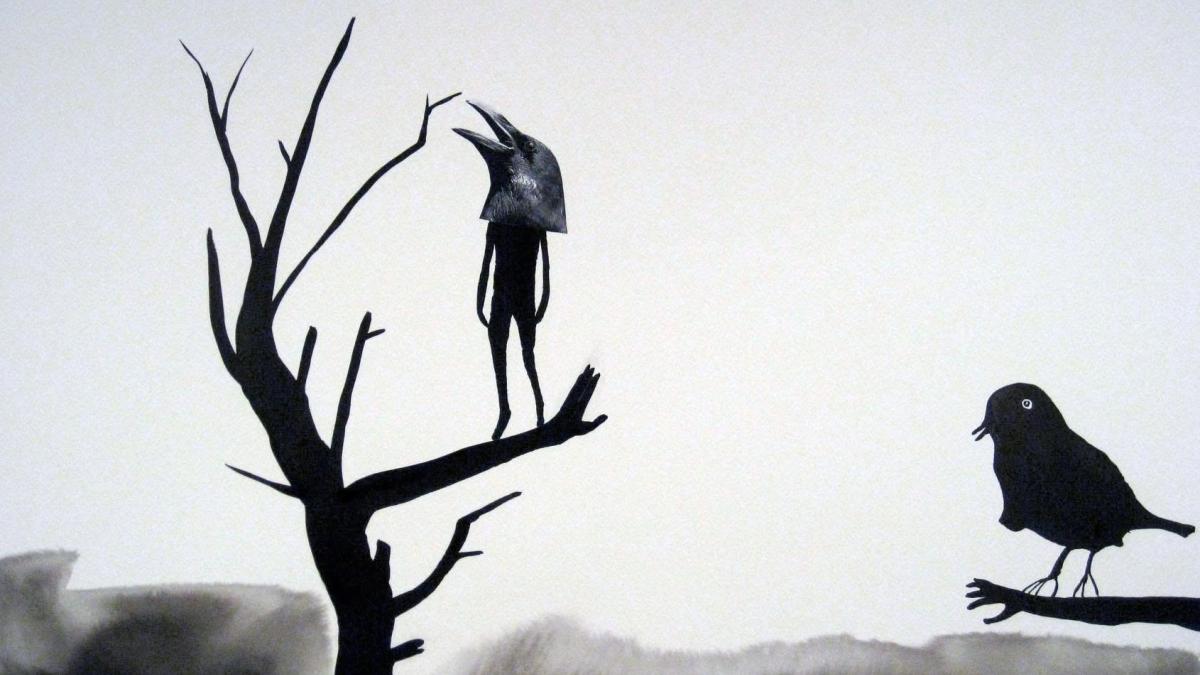
Hermione Pine, amateur entomologist and botanist, leaves the city to make a home inside a tree in the Great Northern Forest. Accompanied by her friend Pince-Nez the crow, she observes insects, gathers firewood, hunts, and attempts to make sense of her new surroundings. One of Andrews’ early hybrid works, Woods Marm uses puppetry, hand-drawn animation, and the conventions of midcentury educational films to tell the story of an unconventional heroine whose study of the world becomes a lesson in how to live within it.
Monkeys and Lumps
2003, 38 minutes
With Monkeys and Lumps, Andrews introduced Ima Plume, an intrepid “public illustrator” and self-appointed investigator of the unexplained—a character she would return to in a trilogy of works. Weaving together Jane Goodall’s primate research, the U.S. chimpanzee space program, and news reports of mysterious sea “globsters,” Andrews combines hand-drawn animation, puppetry, live action, and found footage in a funny and searching meditation on the shifting boundary between the known and unknown worlds.
Behind the Eyes are the Ears
2010, 26 minutes
Part horror film, part speculative science, Behind the Eyes are the Ears turns Andrews’ fascination with animal perception toward the possibilities—and dangers—of extending human senses. Mixing puppetry, live action, found footage, and genre conventions drawn from ethnographic films and mad-scientist cinema, the film imagines bodily transformation as a route toward new forms of consciousness. Its ideas would later expand into Andrews’ feature The Strange Eyes of Dr. Myes (2015).
She Had Some Work Done
2025, 3 minutes
One of Andrews’ final films, She Had Some Work Done transforms wardrobe-test footage of Marilyn Monroe for the unfinished film Something’s Got to Give (1962) to explore how beauty is constructed and internalized. Playful and uncanny, the film marks a shift in Andrews’ animation style while remaining rooted in her longstanding fascination with the body and its capacity for transformation.
ABOUT THE ARTIST
Nancy Andrews (1961–2026) was an artist, filmmaker, animator, musician, and educator whose expansive practice encompassed film, performance, drawing, installation, sculpture, music, and publications. Born in Syracuse, New York, Andrews received her bachelor of fine arts from the Maryland Institute College of Art in 1983 and her master of fine arts from the School of the Art Institute of Chicago in 1995. She joined the faculty of College of the Atlantic in Bar Harbor, Maine, in 1999, playing a central role in the development of the college’s film and media arts program during her 25-year career there.
Andrews’ films include Monkeys and Lumps (2003), The Dreamless Sleep (2004), On a Phantom Limb (2009), The Strange Eyes of Dr. Myes (2015), and I Like Tomorrow (2021), co-directed with Jennifer Reeder. Moving fluidly between cinematic and visual art, she also published the graphic novel Loupette and the Moon in 2012 and adapted The Strange Eyes of Dr. Myes into a Gotham Award–winning web series. In addition to her art-making, Andrews played in the Baltimore art-punk group Ceramic Madonna Head (with Plastic Arms) (Andrews, Linda Smith, Elizabeth Downing, and Peggy Bitzer) and cofounded the performance-art band Lambs Eat Ivy (Andrews, Downing, Michael Willis, and Jonathan Gorrie). Her later musical projects included the Gertrudes (Andrews, Smith) and the solo recording alias Pinky. She reunited with Smith for the album A Passing Cloud (2023) and toured with her in 2026.
Andrews’ films have screened internationally, including at the Museum of Modern Art, International Film Festival Rotterdam, Pacific Film Archive, Anthology Film Archives, Flaherty Film Seminar, and Ann Arbor Film Festival, among many others. Her visual and installation work was exhibited at the 2013 deCordova Biennial and Center for Maine Contemporary Art. Six of her films are held in MoMA’s collection. A 2008 Guggenheim Fellow in filmmaking, Andrews also received support from the National Endowment for the Arts, Franklin Furnace Fund, Illinois Arts Council, LEF New England, and Ellis-Beauregard Foundation.
ACCESSIBILITY
All CATE events include real-time captioning (CART). The Siskel Film Center is ADA accessible. Its theaters are equipped with hearing loops. For more accessibility information or to request additional accommodations, visit saic.edu/access or email cate@saic.edu.
TICKETS
$14 General public
$9 Students & seniors
$8 Film Center members
$8 SAIC staff & faculty & AIC staff
FREE for SAIC students with a valid ID
All CATE programs are free for SAIC students. Unless otherwise noted, SAIC student tickets are released five days prior to showtime. Tickets must be picked up in person from the Gene Siskel Film Center box office. A student ID is required.
CONVERSATIONS AT THE EDGE
For 25 years, the Siskel Film Center’s award-winning Conversations at the Edge series has welcomed landmark and emerging artists to Chicago for adventurous screenings, performances, and conversation. Bringing together an extraordinary breadth of forms, traditions, and histories, CATE explores—and expands—our sense of what moving images can do. CATE is made possible through the Siskel Film Center’s ongoing collaboration with SAIC’s Department of Film, Video, New Media, and Animation. The series is organized by Amy Beste, director of public programs at SAIC.